
You went up to the attic for the Christmas bins and found them: small dark pellets scattered along the insulation and stored boxes. In a Burlington home in November, that is rarely a one-night visit. Mice move into attics as the nights turn cold, and droppings are the sign you can actually read — if you know what you are looking at, and what not to touch. Here is how to read the sign, tell a current problem from an old one, and clean up safely.
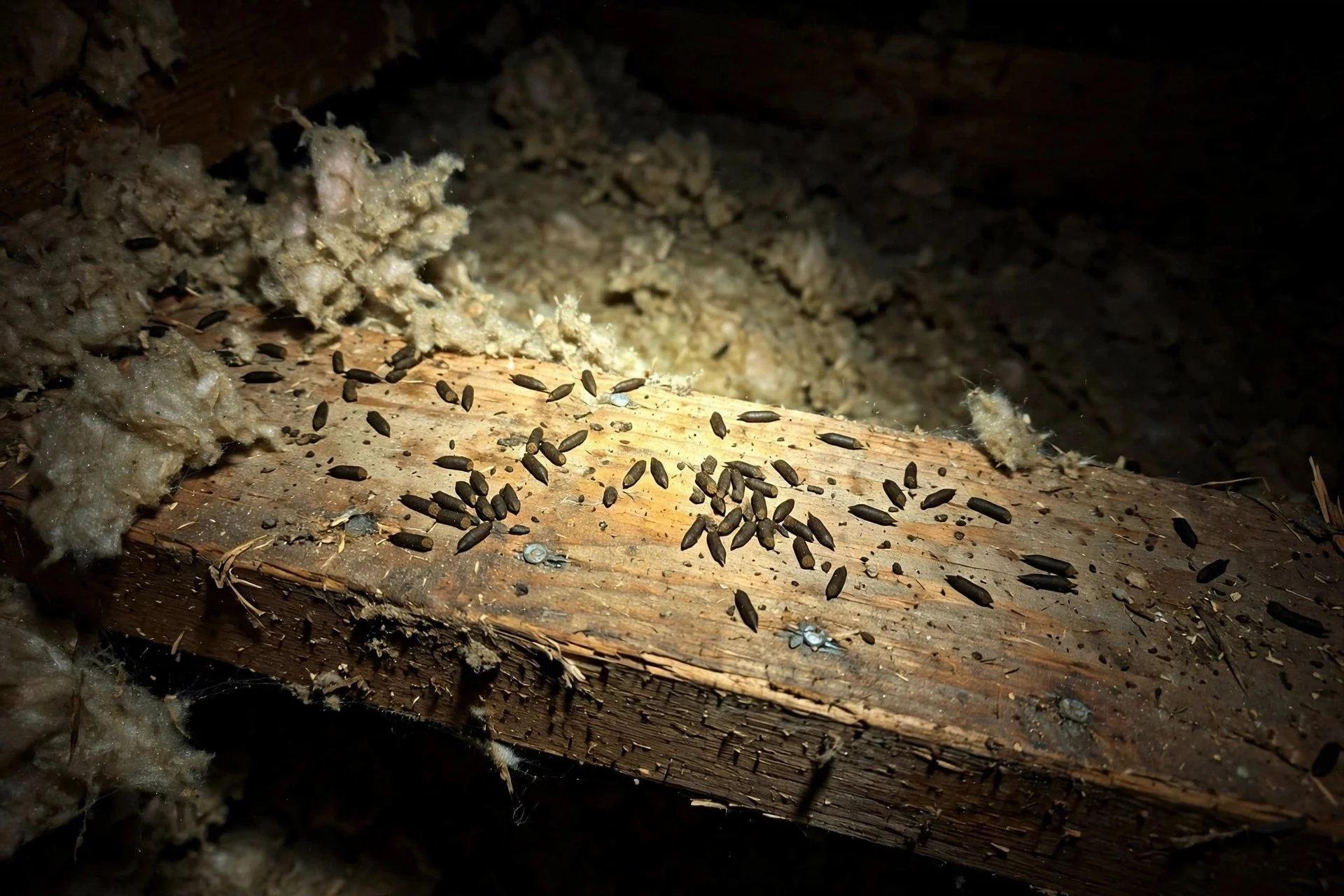
Mouse droppings along an attic top plate in a Burlington home. Regional Wildlife Services serves Burlington, Oakville, Milton, Hamilton, Stoney Creek and Niagara — 905-320-8984.
What mouse droppings in the attic actually look like
Mouse droppings are small, dark and easy to walk past. Read them from standing height, with a flashlight — not with your hands:
Size and shape. About 3 to 6 mm long — the size of a grain of rice — thin, and pointed at one or both ends. Black to dark brown.
Scattered, not piled. Mice drop as they travel, so droppings spread along their routes: along the top plates of the walls, at the edges of the attic floor, across disturbed insulation, and on stored boxes. A tight pile in one repeated spot is a different animal's habit — see below.
Fresh vs. old. Fresh droppings are dark, shiny and slightly soft. Old ones dry out, turn dull and greyish, and crumble. Fresh sign in November means mice are here now.
The company droppings keep. Droppings alone are one sign. The full picture adds flattened runways tunnelled through loose insulation, a nest of shredded paper, fabric or insulation in a sheltered corner, fine gnaw marks on boxes and stored items, and a stale, musky, ammonia-like smell from urine-soaked insulation.
One sign can be a maybe. Fresh droppings plus a runway plus light scratching overhead after dark is mice.
Mice droppings attic signs — or something bigger?
Droppings get misread both ways, and the fix depends on the animal:
Rat droppings are several times larger — roughly 12 to 18 mm long, thick, and blunt-ended rather than pointed. If you can make out the shape of a single pellet while standing up, it is too big to be a mouse dropping.
A raccoon does the opposite of scattering. Raccoons return to one spot again and again and build a latrine — droppings concentrated in one attic corner, with heavy thumping at night to match. Scattered rice-sized pellets are not a latrine.
Sound backs up the sign. Mice are light and quick, and active only at night. Daytime noise with louder chewing points to a squirrel; slow, heavy movement after dark points to a raccoon. Droppings, timing and weight together name the animal — which is why mice removal starts with reading the sign.
The health risk, stated plainly
Mouse droppings deserve respect, not panic:
Mice and rats can carry disease, and droppings, urine and nesting material are the contact points. Health Canada identifies the deer mouse — brown or grey with a white belly and feet, the mouse that moves into buildings near fields and woodlands in the fall — as the most common carrier of hantavirus, a rare but serious illness.
Droppings alone cannot tell you which mouse left them. House mouse and deer mouse droppings overlap in size and shape; the species is told by the animal, not the pellet. So every cleanup follows the same cautious method, whoever left the sign.
The risk concentrates at cleanup time. You do not get sick from looking at droppings. The danger is disturbing them dry — sweeping or vacuuming raises dust you would rather not breathe. Health Canada's rule is blunt: never sweep or vacuum dry droppings.
How to clean up safely — and where the DIY line sits
For a small find — a scattering on a hard surface or on a stored box — Health Canada's method is a wet cleanup, start to finish:
Air the space out. Open the attic hatch and any windows or doors and let the area ventilate first — Ontario's guidance uses a half hour before and after cleaning.
Glove up, mask on. Rubber or plastic gloves, and a well-fitting mask in a closed, poorly ventilated attic.
Soak, don’t sweep. Dampen the droppings and debris thoroughly with a bleach-and-water solution or household disinfectant until wet through.
Wipe up wet. Pick everything up with paper towel or a damp cloth, bag it, and wash the surface with disinfectant. Health Canada's rats and mice guidance walks through the same steps.
Finish clean. Wash gloved hands before removing the gloves, then wash your bare hands with soap and water, and wash exposed clothing.
Where the line sits: droppings spread through loose insulation, heavy urine staining, or a nest worked into the insulation is not a paper-towel job. Disturbing fouled insulation in an enclosed attic is exactly the exposure the wet method prevents — that scale gets assessed first.
Cleaning up is not the fix — sealing is
A cleaned attic with the entry points still open is an invitation with fresh paint. Mice got in through gaps as small as a dime — around pipes and cables, at the foundation, at the garage, up the wall to the roofline — and the next mice will use the same doors. Bait closes none of them; it is a band-aid you keep paying for, and a mouse that dies in a wall void announces itself for weeks.
On wildlife removal in Burlington mice calls, the order is:
Inspection. Attic sign read properly — droppings, runways, nests, routes — and the whole exterior checked, foundation to roofline, for every gap.
The mice inside are dealt with as part of the plan, in the right order — never sealed in.
Every entry point sealed permanently with materials mice cannot chew through, so the routes through your walls and attic have no doors left.
Cleanup scoped honestly from what the inspection found — a light scattering is one conversation; a season of fouled insulation is another.
Frequently asked questions
How do I know the droppings in my attic are from mice and not rats?
Size is the reliable test. Mouse droppings are 3 to 6 mm, rice-sized and pointed; rat droppings run roughly 12 to 18 mm, thick and blunt-ended. Pattern helps too — mice scatter along routes, while a raccoon concentrates droppings in one latrine spot. An inspection confirms the animal.
Are mouse droppings dangerous to my family?
The risk is real but narrow, and it sits in the cleanup, not the looking. Droppings, urine and nests can carry germs — Health Canada names the deer mouse as the most common hantavirus carrier — and dry sweeping or vacuuming puts contaminated dust in the air. Wet cleaning with gloves keeps the risk down.
I found old, grey droppings but hear nothing. Do I still have mice?
Maybe not — old droppings can sit in an attic for years. Grey and crumbly, with no fresh sign and no night noise, usually means past activity. The gaps they used are still worth sealing, because an open route gets reused — and fresh dark droppings after a safe cleanup mean the activity is current.
Can I just vacuum the attic with a shop vac?
No. Health Canada is explicit: never sweep or vacuum dry droppings — the dust raised can cause illness. Droppings get soaked with disinfectant and wiped up wet, and droppings in insulation get assessed, not vacuumed.
Why not just put bait in the attic and be done?
Bait deals with the mice inside today and closes none of the dime-sized gaps they used — and Health Canada itself says baits and poisons should not be the only method used. Sealing every entry point ends the cycle instead of renting it.
Found droppings in the attic?
Call Regional Wildlife Services at 905-320-8984, or reach us through the contact page. You will get Sean Thornton, owner-operator — 20+ years removing wildlife humanely — an inspection that reads the sign and finds every entry point, and a home sealed permanently instead of a bait program. Phone calls and bookings are taken 7 days a week; service appointments run Monday to Friday typically. Serving Burlington, Oakville, Milton, Hamilton, Stoney Creek and Niagara — call 905-320-8984.
