
You have heard the noise for two or three nights now — something moving over the ceiling, or scratching from inside a wall — and you have booked an inspection. Then the obvious question lands: what actually happens when the inspector gets here? This post walks through a wildlife removal visit in Burlington step by step, so you know what gets checked and what you should be told before anyone talks about sealing a single hole.
It starts with what you have been hearing
The visit starts with your account, because the pattern you have lived with is real evidence. When the noise happens, how heavy it sounds, and which room it is loudest in all point somewhere:
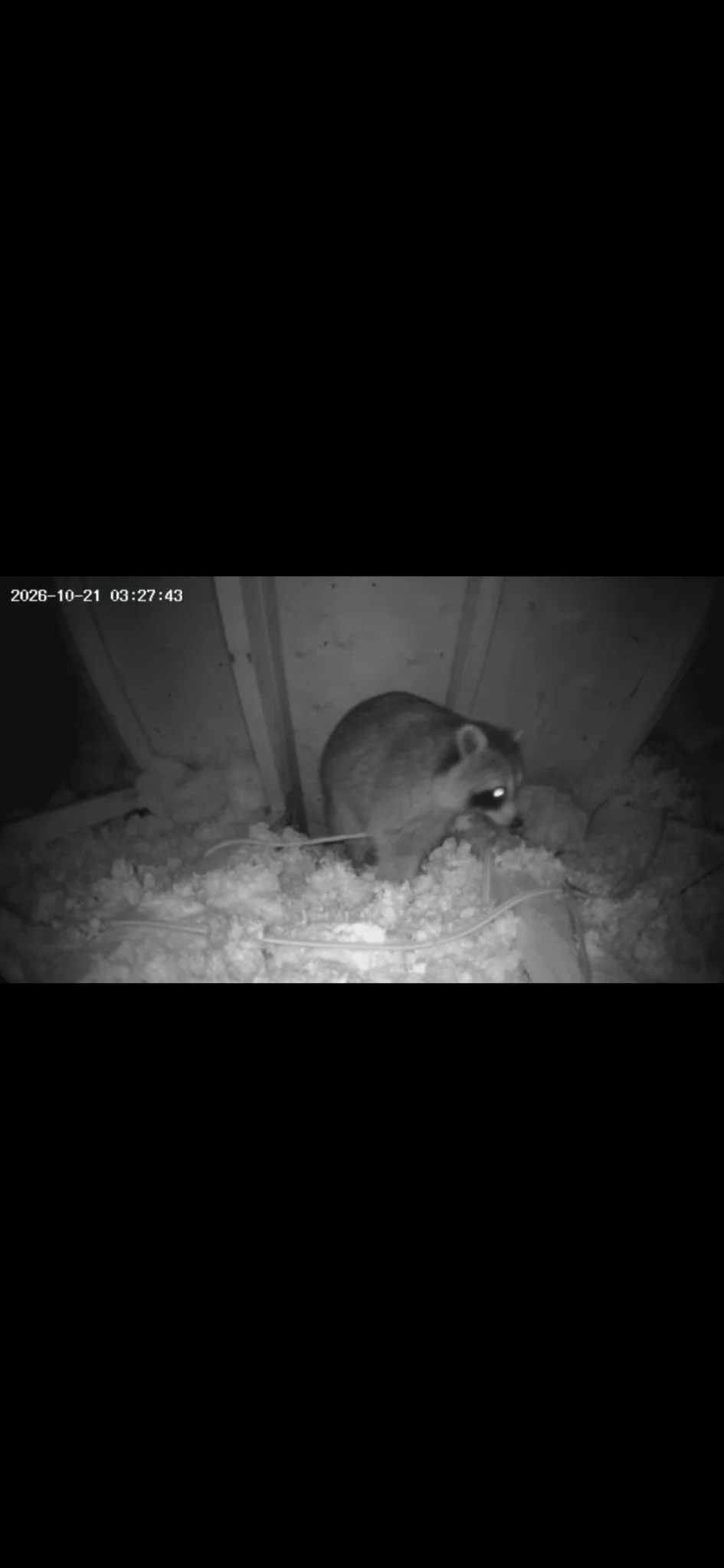
- Heavy, slow movement at night points to a raccoon — a substantial animal walking the attic, not scurrying across it.
- Fast scampering in the morning and again late in the day points to a squirrel. Squirrels are daytime animals, and they chew — on entry edges, wood, and sometimes wiring.
- Faint scratching or short scurries inside a wall, at night, points to mice — much lighter, and often in the walls rather than across the open ceiling.
One night of noise proves little. A pattern that repeats, in the same place and at the same hours, is what an inspection is built on. If you noted the times and rooms, bring those notes.
The outside check: the roofline tells the story first
Before the attic hatch opens, the outside gets read. Animals do not appear in an attic — they travel to it, and the route usually shows.
The roofline is checked vent by vent, soffit by soffit: a vent ripped or torn open, a soffit corner pushed loose, lifted shingles, and the seal around plumbing stacks. Raccoons work with their hands and tear at weak points; squirrels chew through a smaller gap. The chimney is checked too — an uncapped chimney is a ready-made den. Ground level gets the same attention: gaps where pipes and wires enter, and small foundation openings, because mice fit through a hole the size of a dime.
The check does not stop at the hole in use tonight. Every other weak point gets mapped too — close one door on an animal that knows this attic, and it will test the next one.
The attic check: reading the evidence inside
Inside, the attic confirms what the roofline suggested — outside entry matched to inside evidence:
- Droppings, and where they sit. Raccoons use one repeated latrine spot. Mice scatter small droppings along the runs they travel. Squirrels leave nesting material and stored food tucked into corners.
- Trails and damage in the insulation. Flattened paths, tunnelling, and soiled or torn-up insulation show where the animal travels and where it sleeps.
- Chew marks. Chewed wood, and wiring that has been chewed, is squirrel sign — and the wiring is why a squirrel attic is not a wait-and-see problem.
- The entry from inside. Daylight showing at a vent, soffit or roof edge ties the inside evidence back to the exact outside opening.
The attic also answers the question that changes the whole plan: is anything young in there? Young cannot use a one-way door on their own, so nothing is closed until it is clear whether the attic holds a single animal or a family. Old sign and fresh sign are separated too — a past tenant's droppings do not prove tonight's noise is the same animal.
What a wildlife inspection actually decides
By the end, four things should be settled — not guessed:
- Which animal it is. Raccoon, squirrel, mice, or something else — because each one is removed differently. Raccoon removal, for example, is built around strength: an animal that tears at vents and soffits needs a different door and different sealing than a squirrel that chews.
- Every entry point — the one in use, and the ones that would be next. One hole found is a partial inspection.
- Whether young are present, and how they will be dealt with and reunited outside if they are.
- What damage needs attention — insulation, latrine cleanup, chewed material — stated honestly, including anything that belongs to another trade.
Ontario's own guidance on preventing and managing conflicts with small animals starts from the same order: identify the animal, then deal with the openings. An inspection that skips the identification and jumps straight to sealing has the order backwards.
What happens next: the plan you should be given
The inspection ends with a plain explanation of the plan, before any work is agreed. On a humane job, it runs in this order:
- One-way door on the main entry. The door lets the animal leave on its own, as it does every night to feed, and does not let it back in. No animal is sealed inside — sealing an occupied attic traps it, and it will tear at everything trying to get out.
- Young accounted for first, if the inspection found any — dealt with as part of the job and reunited with their mother outside, never left behind a sealed entry.
- Sealing, once the attic is confirmed empty. Every entry point from the inspection map gets sealed — the used one and the weak ones — so the next animal finds a closed house. For mice, this sealing of the home's entry points is the whole job: a permanent fix, instead of a bait program you keep paying to repeat.
- Cleanup where it is needed, based on what the attic check actually found.
If live trapping is ever required instead, Ontario law limits release to within 1 km of where the animal was caught — one more reason the one-way door, which lets the animal walk out on its own, is the standard method.
A proper inspection is not a glance at one hole and a quote on the spot, and it is not a hole sealed the same visit, before the animal is out. The findings are evidence you can be shown, entry by entry.
Frequently asked questions
Do I need to go into the attic before the visit, or during it?
No. Read the signs from the rooms below and from the ground — the times, the weight of the noise, any torn vent you can see without a ladder. A cornered animal in a confined attic can be aggressive, and droppings are not something to handle without protection. The attic work is the inspector's job.
What if the inspection finds old sign but no animal tonight?
That happens, and it is still useful. Old sign means the attic has been used before and the entry is likely still open. The weak points can be sealed once nothing is inside, so the next tenant does not move into a ready-made den.
Can one inspection cover raccoons, squirrels and mice at once?
Yes — the same visit reads all three. The evidence separates them: heavy night movement and a latrine for a raccoon, daytime scampering, chewing and stored food for a squirrel, faint wall scratching with small droppings for mice. The plan is then built for the animal that is actually there.
Why not just seal the hole I can see?
Because it may not be the only one, and the animal may still be inside. Sealing first traps it or sends it to the next weak point. The order matters: identify, let it out humanely, confirm the attic is empty, then seal everything the inspection mapped.
What should I have ready when the inspector arrives?
Very little. Access to the attic hatch, your notes on when and where the noise happens, and pets kept out of the way. Photos you took from the ground of anything on the roofline help too.
Regional Wildlife Services is Sean Thornton, owner-operator — 20+ years of humane wildlife removal across Burlington, Oakville, Milton, Hamilton, Stoney Creek and the Niagara region. If something has moved into your Burlington attic and you want to know exactly what you are dealing with, call 905-320-8984 — phone calls and bookings are taken 7 days a week, with service appointments Monday to Friday typically. Or reach us through the contact page and tell us what you are hearing.
